
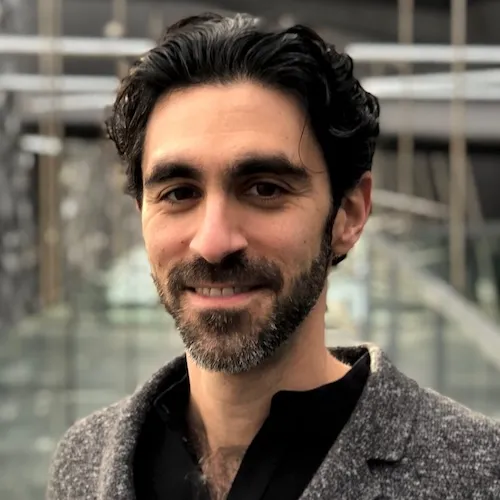
Ziad Obermeyer works at the intersection of medicine and AI, asking fundamental questions about how data can transform health and health care. He is Associate Professor and Blue Cross of California Distinguished Professor at UC Berkeley, and a founding member of the Berkeley–UCSF joint program in Computational Precision Health. His... Read more
Ziad Obermeyer works at the intersection of medicine and AI, asking fundamental questions about how data can transform health and health care. He is Associate Professor and Blue Cross of California Distinguished Professor at UC Berkeley, and a founding member of the Berkeley–UCSF joint program in Computational Precision Health.
His work helps doctors make better decisions, and helps researchers make new discoveries by ‘seeing’ the world the way algorithms do. The resulting algorithms are being deployed into real world settings, bridging the gap between computational innovation and patient care. His research on algorithmic bias, which culminated in testimony before Congress, changed how hospitals around the world use AI for population health, and how state attorneys-general hold AI accountable.
Beyond academia, Ziad Obermeyer co-founded Nightingale Open Science, a non-profit that democratizes access to medical imaging data, and Dandelion, a for-profit platform for AI innovation in healthcare. He is a Chan–Zuckerberg Biohub Investigator and a Research Associate at the National Bureau of Economic Research. TIME magazine named him one of the 100 most influential people in AI, and the National Academy of Medicine recognized him as an emerging leader.
He practiced emergency medicine for 10 years, from academic hospitals to rural Arizona, and is now building a new kind of medical practice grounded in massive data collection and rapid experimentation. Before Berkeley, Obermeyer served on the faculty at Harvard Medical School and began his career as a consultant at McKinsey & Company.
AI is a powerful new tool for making sense of high-dimensional signals (images, waveforms, etc.) that humans struggle to process. In medicine, this is already starting to produce empirical discoveries that can drive theoretical insights. Rebooting this flow of ideas from ‘bedside to bench’—historically a key driver of progress, but...
Every year, hundreds of thousands suffer sudden cardiac death. What makes these deaths so tragic is that many are preventable, with an implanted cardioverter defibrillator (ICD)—if only we could know who was at high risk before they died. Using a massive new dataset of ECGs linked to death certificates, we...
Despite enormous optimism around AI in health care, it’s easier to find examples of algorithms causing harm than doing good. I’ll argue that the root of these problems is the design principle underlying many of today’s AI tools: automation of (flawed, biased) human decision making. Drawing on my own work,...
Algorithms can reproduce and even scale up racial biases. We demonstrate widespread bias in a widely used family of algorithms in health care, which predict health care costs as a proxy for health needs. Because Black patients face unequal access to care, they cost less than White patients with the...
Despite great optimism, actual applications of ML to health are in short supply. Using a concrete example, I’ll argue that the bottleneck is not financial or behavioral, but the scarcity of usable clinical data. I’ll also show how two data platforms, that allow safe and ethical access to health data,...