
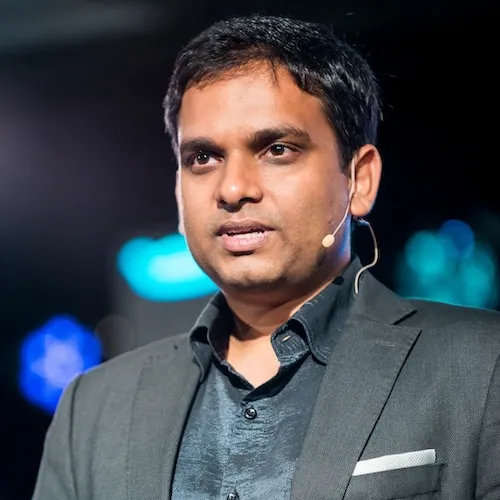
Sangeet Paul Choudary is one of the world’s most influential voices on AI strategy, platform economics, and the future of industry transformation. A globally acclaimed strategist, author, and scholar, he advises governments, Fortune 500 companies, and major technology leaders on how AI will reshape coordination, workflows, business models, and competitive... Read more
Sangeet Paul Choudary is one of the world’s most influential voices on AI strategy, platform economics, and the future of industry transformation. A globally acclaimed strategist, author, and scholar, he advises governments, Fortune 500 companies, and major technology leaders on how AI will reshape coordination, workflows, business models, and competitive advantage across sectors.
Sangeet is the award-winning author of Reshuffle: Who Wins When AI Restacks the Knowledge Economy, which was recently honored with the 2025 Thinkers50 Strategy Award for the most impactful idea in strategy. The book reframes the global AI conversation by arguing that coordination—not cognition—is AI’s true economic superpower. Through this lens, Reshuffle reveals how AI is reorganizing industries, redistributing power, and reshaping the foundations of the knowledge economy, equipping executive leaders with a practical framework to navigate disruption and structural change.
He is also the co-author of the international bestseller Platform Revolution—a seminal work with over 300,000 copies sold globally and one of the most cited books in the field of platform economics. His follow-on works, Platform Scale and Platform Scale for a Post-Pandemic World, further establish him as a leading authority on how platform models transform value creation, competition, and governance.
Sangeet’s Harvard Business Review article Pipelines, Platforms, and the New Rules of Strategy was named one of HBR’s Top 10 Management Ideas of 2017 and is among the rare works selected for four HBR 10 Must Reads anthologies, placing him alongside thinkers such as Michael Porter and Clayton Christensen.
Recognized as a Young Global Leader by the World Economic Forum and repeatedly ranked by Thinkers50 among the world’s top management thinkers, Sangeet has also been featured across global media including The Economist, Wall Street Journal, The New York Times, Wired, Forbes, and Bloomberg TV.
In academia, he serves as Senior Fellow in Competition Policy at UC Berkeley’s Haas School of Business and as a Non-Resident Scholar at Dartmouth College’s Arthur L. Irving Institute for Energy & Society. He has previously co-chaired the MIT Platform Strategy Summit, served as Entrepreneur-in-Residence at INSEAD, and held research affiliations with the Brookings Institution, the International Labour Organization, and The Centre for Global Enterprise.
As a strategic advisor, Sangeet has worked with executive teams at more than 40 Fortune 500 companies, including Nestlé, ExxonMobil, Daimler, ING, American Eagle, and Booking.com. He has also served on boards and advisory councils including the Monetary Authority of Singapore’s ASEAN Financial Innovation Network, Standard Bank, ING’s Global Innovation Council, and the World Economic Forum’s Global Future Council on Platforms and Systems.
A sought-after keynote speaker, Sangeet has addressed the G20 Summit, the World Economic Forum, the United Nations, and senior leadership gatherings at Microsoft, AT&T, Schneider Electric, and Accenture. His frameworks are used globally to help leaders anticipate value migration and build conviction on what the AI-powered future means for economies, industries, and institutions.
Why the next decade won’t be about digitization — but about re-architecting industries around AI-driven coordination.
Why agentic systems will rewrite competition, erode traditional moats, and create new orchestration opportunities.
Why AI is not automation but a new coordination architecture that reshapes entire systems.
How leaders can build sustainable differentiation in a world of abundant AI capabilities.
How AI reorganizes workflows, industries, and competitive advantage — and what leaders must do now.
A deep dive into value migration and how business models evolve as AI becomes the organizing layer.